

Impact of Ocean Acidification on the Intestinal Microbiota of the Marine Sea Bream (Sparus aurata L.)
Brief Research Report Article Description
The objective of this study was to look at how increased levels of carbon dioxide in the ocean affect the gut bacteria, or microbiota, of sea bream fish. It was found that when the fish were exposed to higher CO2 levels, their gut bacteria changed, with some helpful bacteria decreasing and potentially harmful bacteria increasing. This shift may be related to different chemical and physiological compensatory processes, thus provoking an imbalance in gut bacteria and possibly causing slower digestion in fish under high CO2 conditions. This research suggests that understanding these changes in fish gut microbiota is essential for studying how fish’s health and immune responses might be affected by ocean acidification caused by climate change.
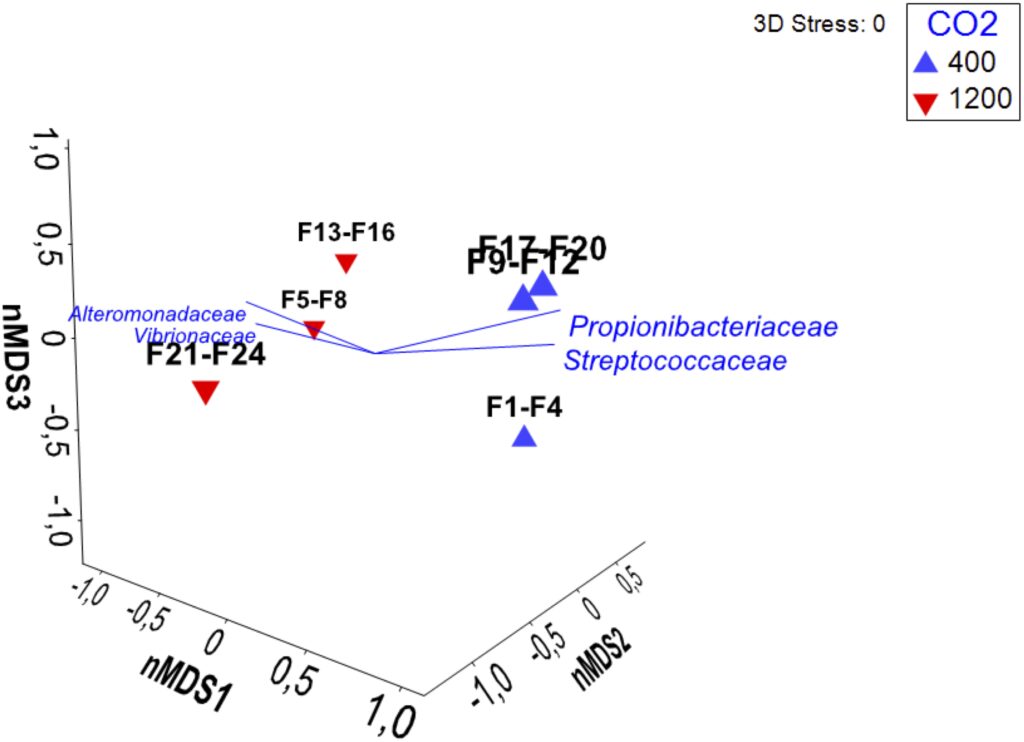
“FIGURE 2. Non-metric multidimensional scaling (nMDS) plot based on Bray–Curtis similarity among microbial communities of S. aurata intestinal fluid samples, obtained from fish grown at 400 μatm CO2 (F1–4; F9–12; F17–20) and at 1200 μatm CO2 (F5–F8; F13–F16; F21–F24). The plot shows a clear change in community structure with the increase in pCO2 (p = 0.022, Monte–Carlo test). The vectors displayed indicate those OTUs identified as contributing most strongly toward microbiota similarity of samples from the same experimental group using SIMPER analysis. The vector direction for each OUT reflects the Pearson correlations of their square-root transformed counts with the two ordination axes, and length gives the multiple correlation coefficient from this linear regression on the ordination points.” (Fonseca et al., 2019).